
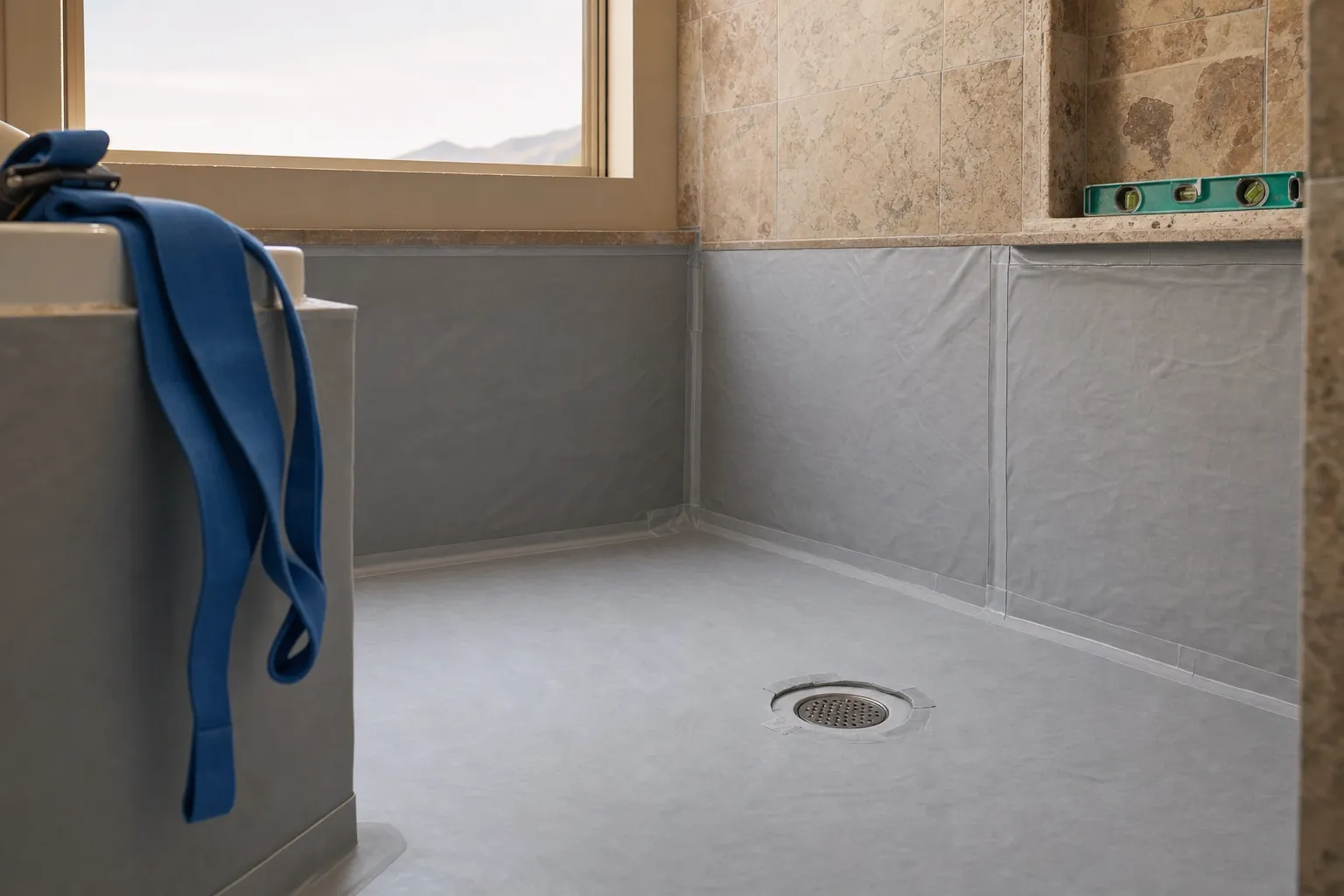
Short answer: for most flooring projects in Cimarron Hills we recommend evaluating and often installing a moisture barrier when the job involves a concrete slab, a below grade space, or any subfloor that shows a history of moisture or temperature swings. Below we explain why, what to ask your installer, how different barrier types perform, and how moisture decisions intersect with subfloor prep and other trades.
What a moisture barrier is, and why it matters
What it is. A moisture barrier is a material placed between the subfloor or slab and the finished flooring to limit water vapor or liquid moisture from reaching the floor covering or adhesive. Common materials include polyethylene sheeting, peel and stick membranes, liquid applied membranes, and integrated underlayments with built in vapor control.
Why it matters in Cimarron Hills and Colorado Springs. Our area has seasonal swings in humidity and temperature, and many homes have concrete slabs or older subfloors that can transmit moisture. Moisture that reaches the finish floor can cause cupping, adhesive failure, mold growth, staining, or delamination. A properly selected barrier reduces those risks and makes sure the flooring performs as intended for years.
Key concepts to understand
- Permeance and vapor control. Permeance measures how much water vapor passes through a material. Some floors need a full vapor retarder, others need just a vapor diffuser. The right choice depends on the floor material and the substrate.
- Liquid moisture versus water vapor. Standing liquid water is different from water vapor moving through concrete. Some products stop liquid, some are designed to control vapor transmission.
- Subfloor type matters. Concrete slabs, plywood, oriented strand board, and tongue and groove planks each behave differently when exposed to moisture.
- Compatibility with flooring and adhesives. Not every membrane is compatible with every adhesive or finish. Manufacturer requirements matter for warranty and performance.
- Edge details and transitions. The barrier must be integrated at perimeter walls, transitions, and penetrations to be effective.
Questions to ask your installer before any flooring work
Ask these questions so you and your contractor make an informed choice about moisture control. We use them on every job to set expectations and avoid surprises.
Pre installation checklist for moisture barriers
- What is the subfloor type and age, and has it ever had a moisture problem?
- Will you test moisture content or gypsum or concrete moisture emission rate, and what passing numbers will you accept?
- Which moisture barrier product do you recommend for this substrate and finish material, and why?
- How will you tie the barrier to perimeter walls, thresholds, and any floor penetrations?
- Are the barrier and installation method compatible with the flooring manufacturer requirements for warranty?
- Will the barrier affect height transitions to adjacent rooms or door clearances?
- Who handles repairs if we find rot, mold, or failing subfloor after the barrier is installed?
Pro tip: Ask to see product data sheets and manufacturer installation instructions for both the moisture barrier and the flooring. Those documents show compatibility limits and are often required for warranty coverage.
How we evaluate moisture risk on site
We follow a consistent process before recommending a barrier or an installation method. We do not perform invasive work unless there is a clear indication to proceed.
- Inspect the space. We look for past water stains, efflorescence on concrete, mold signs, musty odors, and evidence of poor drainage or roof leaks that could affect floor moisture.
- Identify the substrate. We document whether the floor is a concrete slab, plywood, OSB, or a suspended wood joist system with subfloor panels.
- Measure moisture. We take moisture readings with industry standard meters and, when appropriate, order a calcium chloride or relative humidity test for concrete slabs to quantify vapor emission.
- Discuss floor finish requirements. Different finishes, like engineered hardwood, solid hardwood, vinyl plank, or tile, have different moisture tolerances and manufacturer requirements.
- Recommend a solution. Based on inspection and testing we recommend either no barrier, a specific membrane, or corrective work such as leveling, drying, or subfloor repair before the floor goes down.
Common moisture barrier options and how they compare
| Type | Where it is commonly used | Typical advantages | Considerations |
|---|---|---|---|
| Polyethylene sheet membrane | Concrete slabs, new construction | Low cost, simple to install, effective for liquid and vapor when seams are overlapped and sealed | Can be damaged at seams, requires careful edge details; not a structural solution |
| Peel and stick underlayment membrane | Concrete and wood subfloors under engineered or glue down floors | Adheres to substrate, helps with minor substrate irregularities, often rated for vapor control | Surface must be clean and dry; not all adhesives are compatible with every flooring product |
| Liquid applied membrane | Complex shapes, transitions, repairs | Creates a seamless barrier that conforms to odd details and penetrations | Requires curing time, proper thickness, and compatible adhesives |
| Integrated underlayment with vapor control | Floating floors and click lock systems | Simplifies installation by combining cushioning and vapor control | Performance varies by product; check flooring manufacturer requirements |
Note: This table gives qualitative differences. Product technical data sheets are the final word on permeance and compatibility.
When a moisture barrier is not the only answer
Sometimes a barrier is only part of the solution. If the underlying problem is active leaks, poor drainage, roof failure, or a failing HVAC system, the source must be fixed first. Installing a barrier over a damp, failing subfloor only delays the problem and can hide rot or mold.
Watch out: If you see persistent water stains, peeling paint, or a history of flooding, do not rely on a barrier alone. Address the source of moisture and repair or replace damaged materials before finishing the floor.
How moisture control affects related trades and services
Moisture decisions touch other parts of a remodel. We coordinate with related services to make sure the whole project succeeds.
- Subfloor preparation. See our page on subfloor preparation for details on leveling, fastener repair, and replacement priorities.
- Flooring Installation. The chosen barrier affects installation method. Learn how we approach flooring installation projects and the sequencing we use.
- Roofing and drywall considerations. For homes with prior roof damage or interior leaks, our roofing repair and drywall repair teams work with flooring crews to prevent reoccurrence and to keep warranty requirements intact.
Questions specific to homes in Cimarron Hills and Colorado Springs
Local climate factors and common building types affect the choice of barrier.
- Seasonal humidity swings. We consider how seasonal humidity and indoor conditioning patterns will influence vapor drive through slabs and walls.
- Older slab construction. Some older slabs were poured without modern vapor control. We test these slabs and recommend full vapor retarders when warranted.
- Below grade spaces. Basements and walkout slabs need attention to drainage and perimeter walls. A moisture barrier can help but is only one element of a dry basement strategy.
Helpful resources and standards
For background reading on definitions and recommended practices we reference established sources.
- Definition and overview of vapor barriers at Wikipedia.
- Guidance on indoor moisture, mold risks, and mitigation from Colorado State University Extension, which is useful for Colorado homeowners.
- Federal guidance on building moisture control practices and product considerations from the U.S. Department of Energy.
Decision checklist for homeowners
Before you sign a flooring contract
- Confirm the installer will test moisture and show the results.
- Get the product names and data sheets for any recommended barrier and for the flooring.
- Ask how the installer will integrate the barrier with walls and transitions.
- Ask who will repair any hidden damage discovered during prep and how that affects schedule and cost.
- Confirm that the proposed method meets the flooring manufacturer requirements so warranties remain valid.
Key takeaway
Moisture barriers are a necessary protection for many flooring projects in Cimarron Hills, but they are a technical choice that depends on substrate, finish, and local conditions. Test first, choose compatible products, and coordinate with subfloor repairs or other trades to get a durable result.
Frequently asked questions
Do all concrete slabs need a moisture barrier?
Not always. We test concrete slabs for vapor emission and relative humidity before making a recommendation. Many slabs benefit from a barrier, but the necessity and the type depend on test results, the flooring product, and the slab history.
Can I install hardwood over a slab with a moisture barrier?
Yes, engineered hardwood and some glue down systems are commonly installed over slabs with the proper moisture barrier. Solid hardwood has stricter moisture limits. We check both slab conditions and the flooring manufacturer's requirements before proceeding.
What is the difference between a vapor barrier and a vapor retarder?
Vapor barrier is often used as a general term. Technically, a vapor retarder has a defined permeance rating that slows vapor movement but is not completely impermeable. The product choice depends on how much control you need for your specific application.
Will a moisture barrier fix an existing mold problem?
No. A barrier does not treat mold or rot. If mold or damaged materials are found during inspection, those should be remediated and the source fixed before installing a barrier and finishing the floor.
How do moisture barriers affect flooring warranties?
Many flooring manufacturers require specific substrate conditions or approved moisture control methods to keep warranties valid. Always ask for product documentation and follow the stated procedures.
Learn more and check our local reviews
For local examples and to read customer feedback, check our Google Business Profile and our location listings for Colorado Springs and Cimarron Hills. Learn more about moisture control on our topics page and see how we approach flooring work.